
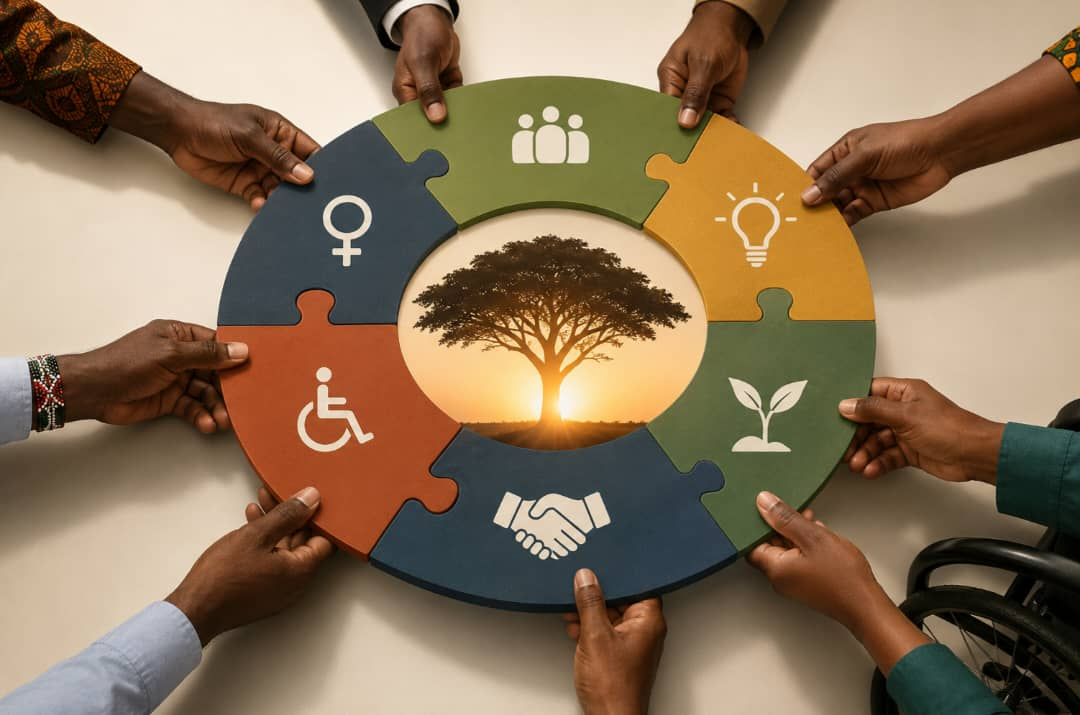

Power is often imagined as something to be possessed, protected, and passed down. Those who have it guard it carefully; those who do not struggle to gain access to it. Across many African societies, political and institutional power has become a fortress—accessible to a few, intimidating to many, and rarely designed around the needs of those outside its walls.
But what if power is not diminished when it is shared? What if, instead, sharing power is precisely what makes societies stronger?
This is the core idea behind inclusive power: a model of leadership and governance in which people are not merely recipients of decisions but active participants in shaping them. It means giving women, young people, persons with disabilities, minorities, rural communities, and other often-marginalised groups meaningful opportunities to influence decisions that affect their lives.
Implementing inclusive power is not about filling seats to create the appearance of representation. It is about ensuring that those seats have a voice—and that the voice can influence outcomes. For African nations struggling with inequality, distrust, and institutional weakness, this model offers the missing framework for sustainable national development.
The Cost of Exclusion in Governance
The consequences of exclusion are visible across the continent. When governance decisions are concentrated in the hands of a small elite, public resources become disconnected from public needs. Top-down policies are imposed without consulting the communities that must live with their consequences.
The result is predictable: mistrust, frustration, inequality, and eventual instability.
Africa’s history repeatedly demonstrates this danger. Colonial rule across the continent was built around control and extraction rather than partnership, co-opting local power structures while excluding indigenous populations from decisions about their resources and institutions.
Independence changed national flags, but in many countries, concentrated power remained. Across different regions, this structural exclusion has manifested in political instability, military coups, ethnic tensions, resource conflicts, weak institutions, and deep economic inequalities.
The Niger Delta in Nigeria provides a clear illustration. For decades, host communities responsible for much of Nigeria’s oil wealth suffered environmental degradation, poverty, and systemic exclusion. The resulting grievances fueled militancy that disrupted petroleum production and imposed massive economic costs on the state.
The broader lesson extends continent-wide: citizens who feel excluded from a system’s benefits eventually question their commitment to that system. When people believe public resources serve only a privileged few, institutional trust erodes, making long-term stability difficult to maintain without embracing inclusive power.
Exclusion Begins at Home
Exclusion is not strictly a governmental issue—it often originates within local and household dynamics.
Across many traditional African settings, family structures historically placed predominant authority in the hands of men. Sons were frequently prioritised for education, inheritance, and family leadership, while daughters were regarded as belonging primarily to another household after marriage.
Such societal norms did more than disadvantage women and girls; they established an early cultural baseline of power as something held by one group over another. That mindset inevitably follows individuals from household environments into workplaces, public administration, and political institutions.
Building truly equitable nations requires examining constitutional frameworks alongside the everyday cultural practices through which citizens learn the meaning of authority.
Lessons from Public Administration
Personal leadership experience in Nigeria’s civil service highlights how practical inclusive power operates in institutional settings.
In 1995, upon being appointed to head the Aba Zone of the then Imo State Agricultural Development Project, administrative challenges arose due to leading senior colleagues with decades of field experience. Rather than asserting top-down authority, adopting a collaborative framework proved essential.
Acknowledging the expertise of senior staff and seeking their mentorship created an environment where technical knowledge was treated as a collective asset rather than a personal threat. This approach enabled the Aba Zone to consistently deliver strong operational outcomes during annual scientific evaluations and field demonstrations.
Effective leadership relies on coordinating talent, recognising expertise, and creating conditions for broad participation rather than attempting total control. African institutions strengthen when leaders view individual competence as a shared resource for progress.
Humanising Policy Through Direct Representation
A subsequent tenure as Permanent Secretary in the Ministry of Women Affairs and Youth Development reinforced the policy impact of direct representation.
During state budget hearings, Nkechi Colewell—a missionary who devoted decades to supporting individuals at the Itumbauzo Lepers Colony in Abia State—attended the sessions in a wheelchair due to partial paralysis. Her direct presentation to the committee shifted abstract fiscal line items into tangible human priorities, securing vital budgetary consideration.
Representation humanises policy development. When individuals directly affected by decisions participate in legislative and budgetary processes, policymakers gain a clearer understanding of real-world outcomes. Through inclusive power, policy beneficiaries become active governance participants.
Regional Models and Continental Imperatives
Elements of inclusive power are already transforming governance across the region.
Rwanda’s high proportion of women in parliament demonstrates how targeted institutional policies alter legislative priorities. Internationally, deliberative models like citizens’ assemblies showcase how structured public participation solves complex policy challenges.
Across Africa, demands are accelerating for young people, civil society organisations, and traditionally underrepresented groups to occupy direct roles in political leadership and economic decision-making. International bodies like the African Union (AU) increasingly emphasise inclusive governance as a prerequisite for long-term continental stability.
Corporate governance history offers similar warnings. The collapse of major global enterprises like Enron demonstrated the risks of insular leadership and unchecked authority. When institutions become echo chambers, critical oversight fails. Diversity of perspective serves as a vital safeguard for both corporate and public governance.
Moving toward inclusive power requires shifting leadership mindsets:
- From control to collaboration
- From ego to empathy
- From exclusion to active participation
- From perceived scarcity to shared capability
Power is not a fixed asset that diminishes when shared; structured delegation and inclusion expand institutional capacity, build trust, and enhance resilience.
Developing sustainable prosperity requires moving beyond viewing citizens as passive voters or beneficiaries. Supporting broader institutional development goals advocated by organisations like the United Nations Development Programme (UNDP) Africa relies on establishing permanent channels for public participation across budgeting, policymaking, and legislative reform.
Building Resilient Governance Frameworks
Adopting inclusive power does not eliminate societal disagreement; rather, it establishes structured, non-violent pathways for resolving competing interests through dialogue and transparent negotiation.
A resilient nation is not defined by total consensus, but by the capacity of its institutions to absorb diverse perspectives without excluding or penalising critical voices.
The African nations that prosper in the coming decades will be those that effectively mobilise the intelligence, technical capability, and energy of their entire populations. Embracing inclusive power provides the practical foundation for building equitable, stable, and prosperous states.
Dr Nnenna Chikezie is a strategic advisor on inclusive budgeting and governance, and the author of “Inclusive Power: How Transformative Policies Shape Nations and Empower People.”