

By Dr Nnenna Chikezie
Power is often imagined as something to be possessed, protected and passed down. Those who have it guard it carefully; those who do not have it struggle to gain access. Across many African societies, political and institutional power has become a fortress—accessible to a few, intimidating to many, and rarely designed around the needs of those outside its walls.
But what if power is not diminished when it is shared? What if, instead, sharing power is precisely what makes societies stronger?
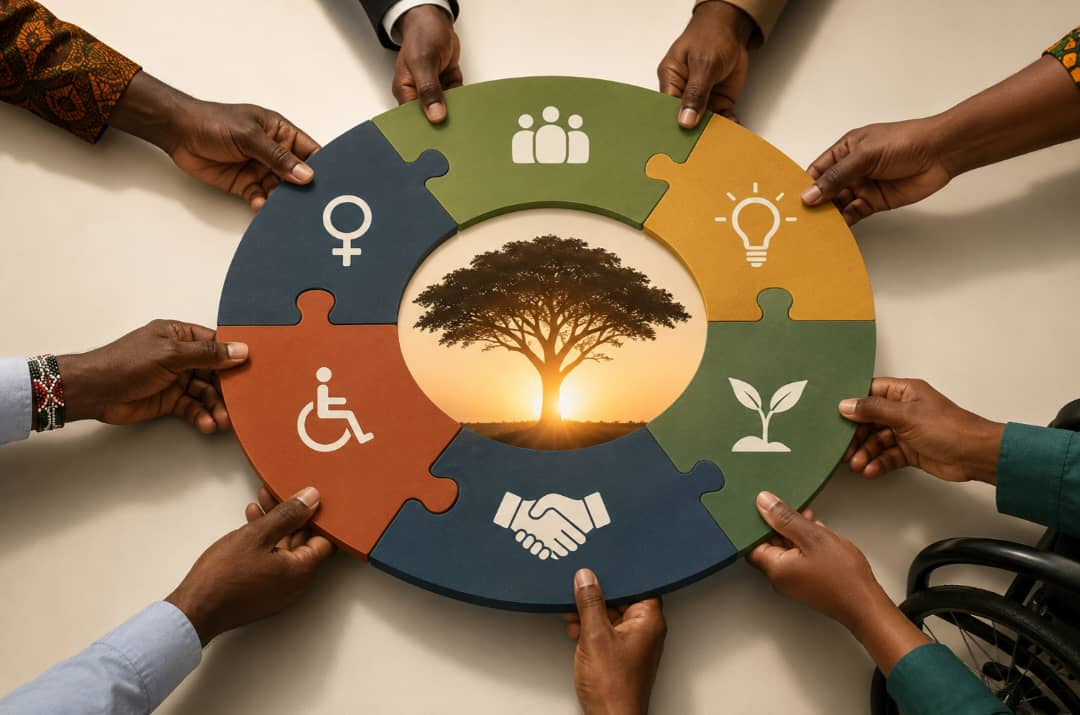
This is the idea behind inclusive power: a model of leadership and governance in which people are not merely recipients of decisions but active participants in shaping them. It means giving women, young people, persons with disabilities, minorities, rural communities and other often-marginalised groups meaningful opportunities to influence decisions that affect their lives.
Inclusive power is not about filling seats to create the appearance of representation. It is about ensuring that those seats have a voice—and that the voice can influence outcomes.
For African nations struggling with inequality, distrust and institutional weakness, this may be the missing ingredient.
The Cost of Exclusion
The consequences of exclusion are not difficult to see. When decisions are concentrated in the hands of a small elite, public resources can become disconnected from public needs. Policies are conceived from the top and imposed from above, while communities that must live with their consequences are rarely consulted.
The result is predictable: mistrust, frustration, inequality and, eventually, instability.
Africa’s history repeatedly demonstrates the danger.
Colonial rule across the continent was built largely around control and extraction rather than partnership. Local power structures were frequently co-opted to serve colonial interests, while indigenous populations were largely excluded from decisions about the resources, institutions and systems that governed their lives.
Independence changed the flags, but in many countries, the concentration of power did not disappear.
In different parts of Africa, this has manifested in political instability, military coups, ethnic tensions, resource conflicts, weak institutions and deep inequalities in access to opportunity.
The Niger Delta in Nigeria provides a particularly powerful illustration. For decades, communities living in areas responsible for much of Nigeria’s oil wealth complained of environmental degradation, poverty and exclusion from the benefits generated by their natural resources. The resulting grievances contributed to militancy that disrupted oil production and imposed enormous economic costs.
The broader lesson extends beyond Nigeria: people who feel excluded from the benefits of a system eventually begin to question their commitment to that system.
When citizens believe that their voices do not matter, that public resources serve only a privileged few, or that institutions exist primarily for those who control them, trust in the system begins to erode.
And once trust disappears, stability becomes increasingly difficult to sustain.
Exclusion Begins Closer to Home
But exclusion is not only a governmental problem. It can begin much closer to home.
Across many traditional African settings, including Nigeria, family structures historically placed significant authority in the hands of men. Sons were often prioritised for education, inheritance and family leadership, while daughters were sometimes regarded as belonging primarily to another household after marriage.
Such practices did more than disadvantage individual women and girls. They established an early understanding of power as something that belongs to one group and is exercised over another.
That mindset can follow people from the home into the workplace, public institutions and political life.
If we want inclusive nations, therefore, we must examine not only our constitutions and institutions but also the everyday cultures through which people learn what power means.
What Leadership Taught Me
My own experience in Nigeria’s civil service taught me a different lesson.
In 1995, relatively early in my career, I was appointed to head the Aba Zone of the then Imo State Agricultural Development Project. I was younger than several members of my team, many of whom had two decades or more of experience. Understandably, there was resistance to my appointment.
I could have responded by asserting my authority. Instead, I chose collaboration.
I acknowledged the experience of my senior colleagues and deliberately sought their knowledge. Although I was the administrative head, I placed myself under their mentorship in areas where their experience was greater than mine.
I did not see their expertise as a threat to my authority; I saw it as an asset to our collective success.
The result was remarkable. The Aba Zone consistently performed strongly during annual scientific visits, demonstrating effective technology transfer to farmers and showcasing Abia State’s achievements.
That experience reinforced a principle that has remained central to my understanding of leadership:
Leadership is not about knowing everything or controlling everyone. It is about coordinating people, recognising talent and creating the conditions in which people can contribute their best.
That principle is relevant far beyond one organisation or one country. African institutions will become stronger when leaders stop seeing the competence of others as a threat to their own authority and begin seeing it as a resource for collective progress.
When Representation Becomes Human
I encountered another powerful lesson years later while serving in the Ministry of Women Affairs and Youth Development as a Permanent Secretary.
Nkechi Colewell, a British missionary who had devoted much of her life to supporting people living with leprosy at Itumbauzo Lepers Colony, Abia State, was now in a wheelchair because of partial paralysis. After previous budget presentations failed, she insisted on attending the budget session herself.
She came.
During the session, she reminded the committee that disability is not someone else’s problem. At some point in life, any of us may become dependent on others.
Her physical presence transformed an abstract budget item into a human reality.
The committee listened.
That moment demonstrated something that statistics often cannot:
Representation humanises policy.
When people directly affected by decisions are present at the table, policymakers are more likely to understand the consequences of their choices.
Inclusion turns beneficiaries into participants and statistics into human beings.
This lesson is especially important for Africa, where public policy often addresses enormous populations through numbers, categories and development indicators. Behind every statistic, however, is a human being whose life will be affected by the decision.
The people most affected by a policy should not always be the last people policymakers hear from.
Africa Is Already Seeing the Possibilities
Across the continent and around the world, similar lessons are emerging.
Rwanda’s high level of women’s representation in parliament demonstrates how deliberate inclusion can reshape institutions. Citizens’ assemblies in places such as Montrose, Colorado, have shown how ordinary people can contribute meaningfully to solving complex public problems when given structured opportunities to deliberate.
African societies are also witnessing growing demands for young people to have a meaningful role in political leadership, economic decision-making and public policy. Across the continent, women, persons with disabilities, civil society organisations, community leaders and other traditionally underrepresented groups are increasingly demanding not simply recognition but meaningful participation.
The corporate world offers another important lesson.
The collapse of Enron demonstrated the danger of insular decision-making and weak oversight. When institutions become echo chambers, uncomfortable questions go unasked and ethical warnings can be ignored.
The lesson applies equally to governments, corporations, families and civil society organisations: when everyone around the table thinks alike, agrees too easily or feels unable to challenge those in authority, the institution becomes vulnerable.
Diversity of perspective is therefore not merely a matter of fairness. It can be a mechanism for better decisions.
From Power Over to Power With
Inclusive power requires more than representation. It requires a change in mindset.
Leaders must move:
from control to collaboration,
from ego to empathy,
from exclusion to participation,
from scarcity to abundance.
They must stop viewing another person’s influence as a reduction of their own.
Power is not a pie that becomes smaller when shared.
In fact, properly shared power multiplies.
When people are given meaningful opportunities to contribute, institutions gain access to knowledge, creativity and experience that would otherwise remain outside the room.
Inclusive governance creates stronger institutions because people develop ownership of decisions. It builds trust because citizens can see and influence how choices are made. It strengthens resilience because diverse communities bring different experiences, knowledge and solutions to national problems.
This matters enormously for Africa.
The continent is young, diverse and rich in human potential. Yet much of that potential remains underutilised when large sections of society are treated primarily as beneficiaries, voters, employees or spectators rather than as co-creators of the future.
The African Imperative
For African nations, this is particularly urgent.
We cannot build sustainable prosperity while large sections of our populations remain spectators in decisions that determine their future.
Women, young people, persons with disabilities, rural communities, minorities and other underrepresented groups must not merely be consulted after decisions have been made. They must be part of the process from the beginning.
This should influence everything from budgeting and policymaking to leadership appointments, institutional reform and community development.
The central point in governance is the people.
That principle should never be reduced to a slogan used during elections. It must become a philosophy of governance.
If governments exist for the people, then people must have meaningful pathways to influence how those governments function.
If institutions serve society, then society must have mechanisms for holding those institutions accountable.
And if nations belong to their citizens, then citizens must have a genuine stake in shaping their future.
Inclusion Does Not Eliminate Disagreement
Inclusive power does not promise a world without disagreement.
Rather, it provides a healthier way of managing disagreement—through dialogue instead of domination, participation instead of exclusion, and collaboration instead of control.
A strong nation is not one in which everyone agrees with those in power.
A strong nation is one in which people can disagree without being excluded, silenced or punished; where institutions can absorb different perspectives; and where competing interests can be negotiated without destroying the social fabric.
That is what makes a nation resilient.
A New Understanding of Power
The African nations that will thrive in the decades ahead will not necessarily be those with the most natural resources, the largest economies or the loudest leaders.
They will be those capable of mobilising the intelligence, creativity and energy of all their people.
Africa’s greatest untapped resource may therefore not be beneath the ground. It may be sitting around the table—people whose ideas, experiences and capabilities have not yet been fully invited into the work of nation-building.
The future, therefore, demands a new understanding of power.
Not power over people, but power with people.
Not leadership that closes the door, but leadership that opens it wider.
Not nations built by a privileged few, but nations strong enough to ensure that everyone has a stake in their future.
Inclusive power is not simply an ethical choice.
It is a practical strategy for building equitable, peaceful and resilient African nations.
Dr Nnenna Chikezie is a strategic advisor on inclusive budgeting and governance. Author, Inclusive Power: How Transformative Policies Shape Nations and Empower People