
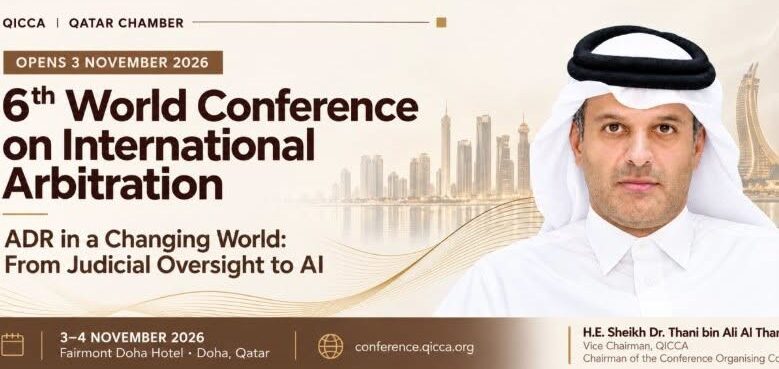

Under the patronage of the Prime Minister and Minister of Foreign Affairs, HE Sheikh Mohammed bin Abdulrahman bin Jassim Al Thani, the Qatar International Center for Conciliation and Arbitration (QICCA), operating under the Qatar Chamber, will host the Sixth World Conference on International Arbitration on November 3–4, 2026, at the Fairmont Doha Hotel. Held under the theme “ADR in a Changing World: From Judicial Oversight to AI,” the conference reinforces Qatar’s transformation into a powerhouse for global conflict resolution.
Vice Chairman of QICCA and Chairman of the Conference Organizing Committee, Sheikh Dr. Thani bin Ali Al Thani, noted that this sixth edition reflects Qatar’s expanding influence. Driven by modern legal reforms, tech-driven rules, and expanding economic outreach, Qatar is establishing a neutral, highly efficient venue for resolving commercial disputes across the Gulf, Asia, and Africa.
The Architectural Pillars of Qatar’s Dispute Resolution Framework
Qatar’s rise as an arbitration powerhouse is not coincidental; it is the product of deliberate statutory and structural legal reforms:
The Modern Arbitration Law (Law No. 2 of 2017)
Qatar’s Law No. 2 of 2017 revolutionized the nation’s legal landscape by fully adopting the UNCITRAL Model Law, aligning domestic arbitration procedures with recognized international standards. The statute grants disputing parties complete autonomy to select their venue, language, rules, and choice of law, removing archaic judicial constraints. By formally severing international commercial arbitrations from traditional court procedures, the law strictly limits local judicial intervention while establishing clear, enforceable grounds for challenging or annulling awards. This modern statutory foundation reassures international corporations and foreign investors that their contractual disputes will be adjudicated independently, predictably, and without administrative bottlenecks in Qatari territory.
The Dual-Track Judicial Safety Net
Qatar features a unique dual-track legal architecture that pairs traditional civil courts with the specialized Qatar International Court and Dispute Resolution Centre (QICDRC). Established within the Qatar Financial Centre, the QICDRC functions as an English-language, common-law court staffed by renowned international judges. This specialized judicial body acts as an essential supervisory and supportive pillar for arbitration. It issues rapid interim injunctions, appoints arbitrators when parties’ deadlocks occur, and streamlines enforcement proceedings. By offering parties a choice between standard civil courts and a world-class common-law forum, Qatar guarantees that arbitration agreements receive swift, highly sophisticated judicial backup tailored to complex global commerce.
Global Legal Interoperability
A world-class arbitration hub requires global award enforceability, which Qatar secures through comprehensive international treaties. As a signatory to the 1958 New York Convention on the Recognition and Enforcement of Foreign Arbitral Awards, arbitral decisions rendered by centers like QICCA carry legally binding force in over 170 contracting states worldwide. Furthermore, Qatar’s commitment to the Singapore Convention on Mediation ensures that cross-border commercial settlement agreements reached through conciliation enjoy direct court enforcement across borders. This international treaty framework eliminates jurisdictional barriers, assuring global corporations that resolving a dispute in Doha yields enforceable financial judgments or settlements anywhere their assets reside.
Understanding arbitration: the alternative to conventional litigation
Arbitration is a form of Alternative Dispute Resolution (ADR) that allows parties to resolve commercial disputes outside conventional court litigation. Through an agreement, parties appoint an independent arbitrator or tribunal to examine the dispute and issue a decision, usually known as an arbitral award. Arbitration offers greater flexibility, confidentiality, and procedural autonomy, while allowing parties to select decision-makers with relevant technical or industry expertise. It is particularly valuable in international commerce, where businesses from different jurisdictions may prefer a neutral forum rather than the courts of one party’s country. Effective arbitration therefore provides investors and businesses with greater predictability, efficiency and confidence in resolving contractual disputes.
From arbitration to a broader ADR ecosystem
Qatar’s approach to dispute resolution extends beyond arbitration to include mediation, conciliation and other forms of Alternative Dispute Resolution (ADR). This broader ecosystem gives businesses different mechanisms for resolving disputes according to their complexity, cost and relationship dynamics. Mediation and conciliation can help parties reach mutually acceptable settlements while preserving commercial relationships, whereas arbitration provides a binding determination when settlement is unsuccessful. Qatar’s updated conciliation framework and commitment to international standards demonstrate its efforts to make dispute resolution more flexible, efficient, and accessible. Together, these mechanisms strengthen Doha’s commercial justice infrastructure and enhance its attractiveness to international investors and businesses.
Why Doha is seeking a position in the Gulf arbitration landscape
Qatar’s ambition to establish Doha as a leading arbitration center forms part of the Gulf’s wider transformation into a global hub for investment, finance, logistics and professional services. As international investment increases, sophisticated mechanisms for resolving commercial disputes become essential. Qatar is therefore developing legal institutions, modern arbitration rules, professional expertise and international partnerships to strengthen investor confidence. This strategy places Doha in competition with established regional centers such as Dubai, Abu Dhabi and Riyadh. By developing a credible and internationally connected arbitration ecosystem, Qatar seeks to complement its economic diversification agenda and position Doha as an important legal and commercial gateway between the Gulf, Africa and global markets.
From Judicial Oversight to Artificial Intelligence
The future of arbitration is increasingly being shaped by technology, particularly artificial intelligence (AI). Traditionally, courts have provided oversight by supporting arbitration proceedings, addressing procedural matters and enforcing arbitral awards. AI is now introducing new possibilities, including faster document review, legal research, evidence analysis, translation and case management. However, its use raises important concerns about confidentiality, accuracy, bias, transparency and due process. Qatar’s focus on AI within its ADR agenda reflects an understanding that future dispute resolution will require both technological innovation and human judgment. The challenge will be ensuring that AI assists arbitrators without undermining accountability, fairness and the parties’ right to a credible hearing.
Why Qatar’s Arbitration Ambitions Matter to Africa
Qatar’s growing arbitration ambitions have important implications for Africa as Gulf investment expands across the continent. Major investments in energy, infrastructure, logistics, agriculture, mining and finance require reliable mechanisms for resolving contractual and commercial disputes. A stronger Qatari arbitration ecosystem could provide African governments and businesses with access to international expertise, professional training and institutional partnerships. It could also strengthen confidence among Qatari and other Gulf investors entering African markets. Beyond resolving disputes, cooperation between Qatari and African arbitration institutions could promote knowledge exchange, develop African arbitration professionals, and strengthen the legal infrastructure supporting Gulf-Africa trade and investment.
What can Africa gain?
Greater Investor Confidence
A stronger Qatar-based arbitration ecosystem can increase investor confidence in African markets by providing credible mechanisms for resolving commercial disputes. This can reduce perceived investment risks, encourage long-term capital commitments, and support stronger contractual relationships between African governments, businesses, and Gulf investors.
Stronger Gulf-Africa Commercial Relations
Qatar’s arbitration ambitions can strengthen Gulf-Africa economic relations by providing legal infrastructure to support growing investment and trade. Cooperation between Qatari and African institutions can promote greater certainty in infrastructure, energy, logistics and financial agreements, making cross-border commercial relationships more predictable and sustainable.
Opportunities for African Arbitration Professionals
Qatar’s expanding arbitration sector can create opportunities for African lawyers, arbitrators, academics and legal practitioners through training, professional exchanges, conferences and institutional partnerships. Greater exposure to international arbitration standards can strengthen African expertise and enable professionals to participate more effectively in complex cross-border commercial disputes.
Stronger African Arbitration Institutions
African arbitration centers can benefit from partnerships with Qatari institutions through knowledge sharing, capacity building and technical cooperation. Such relationships could improve institutional standards, case management, mediation practices and professional development, helping African jurisdictions strengthen their own dispute-resolution systems rather than depending exclusively on established international centers.
AfCFTA and Continental Trade
As the African Continental Free Trade Area expands intra-African commerce and investment, demand for reliable dispute-resolution mechanisms will increase. Qatar’s arbitration development offers opportunities for African institutions to exchange expertise and build international partnerships, supporting a stronger legal framework for the continent’s growing commercial relationships with Gulf economies and global investors.
Qatar’s Next Challenge: Becoming Genuinely International
Qatar’s challenge is to translate its growing arbitration infrastructure into sustained international credibility. Competition from established centers such as Dubai, Abu Dhabi, Singapore, London and Paris remains strong. Doha must continue strengthening institutional independence, arbitrator expertise, procedural efficiency, enforcement, transparency and international partnerships. Consistent quality and successful international cases will ultimately determine whether Qatar becomes a truly global arbitration destination.
A Gulf Hub with an African Opportunity
Qatar’s emergence as an arbitration hub presents an opportunity to deepen Gulf-Africa economic relations. As Qatari investment expands across African energy, infrastructure, logistics and finance, reliable dispute-resolution mechanisms will become increasingly important. Stronger institutional cooperation could connect Doha with African arbitration centers, promote professional exchanges and support greater investor confidence, creating a more integrated commercial bridge between the Gulf and Africa.
Conclusion: A Blueprint for the Future of Global ADR
Qatar’s rise as an international dispute resolution powerhouse demonstrates how deliberate statutory modernizations and advanced technology can transform a country into a legal leader. By bridging civil and common law systems, integrating artificial intelligence into procedural rules, and expanding cross-border partnerships across the Gulf and Africa, Qatar offers a neutral, secure venue for global trade. As international commerce grows increasingly complex, the framework established by QICCA serves as a blueprint for modern alternative dispute resolution. Qatar provides investors with the legal certainty, operational efficiency, and global enforceability required to navigate an evolving world economy.

Seade Caesar, Ch.E. MIoD.
Executive Director
Africa Global Policy and Advisory Institute
ceecaesar@gmail.com