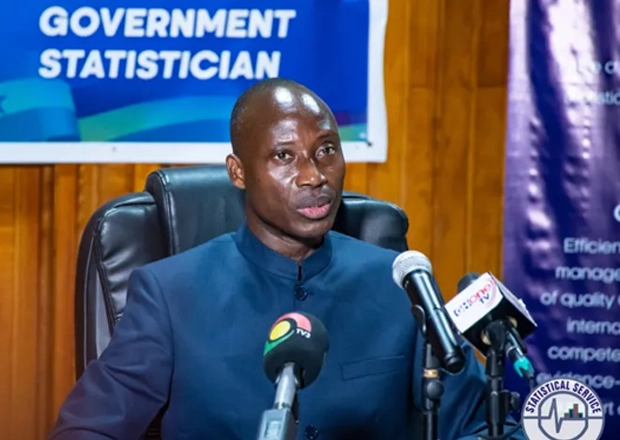
Ghana must treat data as critical national infrastructure if it is to sustain recent economic gains and deliver lasting improvements in living standards, Government Statistician Alhassan Iddrisu has said.
Addressing Parliament’s Economy and Development Committee, Mr Iddrisu argued that investment in data systems should be viewed in the same way as spending on roads, schools and hospitals, warning that weak statistical capacity could undermine policymaking and slow the country’s development agenda.
“We have to begin to treat data and statistics as infrastructure,” he said. “If we do not, there is so much we want to achieve as a nation that we may not be able to achieve because the data simply will not be there.”
His comments come as Ghana seeks to consolidate a marked improvement in economic performance recorded in 2025 after a difficult period of macroeconomic instability. According to Mr Iddrisu, the challenge now is not only sustaining the recovery but ensuring that stronger growth translates into tangible improvements in household welfare.
He argued that in an era defined by overlapping global shocks—including climate change, geopolitical tensions and economic uncertainty—governments must allocate scarce resources more efficiently. That, he said, requires timely and reliable data.
“Decisions must be prudent, timely and targeted. You cannot do that if data is not readily available,” he noted.
The Ghana Statistical Service (GSS) has expanded data production in recent years while placing greater emphasis on making information accessible to policymakers, businesses and households. One example is its recently published multidimensional poverty estimates covering all 261 districts, which track deprivation across income, employment, education and health indicators.
The district-level data, Mr Iddrisu said, gives policymakers a clearer picture of where resources are needed most and enables more targeted interventions. For Members of Parliament, the data provides a detailed assessment of development challenges within their constituencies.
The Government Statistician also highlighted the role of statistics in supporting the government’s proposed 24-hour economy programme. GSS is working with the 24-Hour Economy Secretariat to develop the indicators and datasets needed to measure the initiative’s performance and impact.
Beyond new datasets, the agency is undertaking the rebasing of Ghana’s Gross Domestic Product (GDP) and Consumer Price Index (CPI), a process designed to ensure that key economic indicators accurately reflect current economic realities. Ghana is among a small group of countries that regularly rebase both measures, typically every five years.
Mr Iddrisu said work on the exercise was well advanced and, subject to the timely release of funds, the rebased CPI and GDP series could be completed by mid-2027.
The Ministry of Finance has allocated GH¢207 million in the 2026 budget to support the rebasing exercise and related statistical activities, with part of the funding already released.
Despite the progress, the Government Statistician warned that chronic resource constraints continue to hamper the institution’s work. GSS is operating with about 250 staff, less than half the estimated workforce of 560 required to effectively discharge its mandate.
While welcoming government support, he stressed that sustained investment in statistical systems—not one-off interventions—would be essential to building the data infrastructure needed to underpin economic transformation.
Economic impact
Mr Iddrisu’s intervention reflects a growing recognition that data quality is increasingly becoming a determinant of economic performance. Reliable statistics influence everything from fiscal planning and social spending to private sector investment decisions.
Improved poverty mapping can help government target limited resources more effectively, reducing waste and improving the efficiency of social interventions. Likewise, updated GDP and inflation data provide investors, businesses and policymakers with a more accurate picture of economic activity, strengthening confidence in official statistics and improving economic decision-making.
For Ghana’s broader transformation agenda, including the 24-hour economy programme, robust data systems could become a critical enabler. Without credible and timely statistics, measuring outcomes, evaluating policies and attracting investment become significantly more difficult.
The message from the statistical service is straightforward: sustaining economic recovery requires more than macroeconomic stability. It requires the information infrastructure necessary to guide policy, allocate resources efficiently and track whether growth is translating into better lives for citizens.