
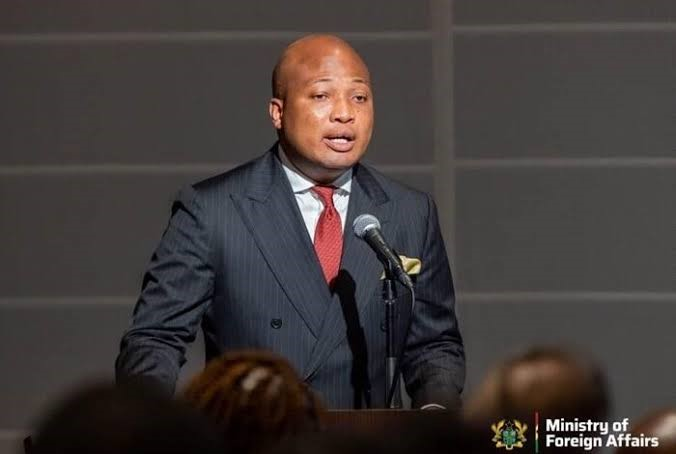

Minister of Foreign Affairs, Samuel Okudzeto Ablakwa, has announced plans by the government of Ghana to establish a Ghanaian Diaspora Consular Fund to provide emergency assistance to citizens who face distress, insecurity or crises while abroad.
According to the Minister, the proposed fund will serve as a dedicated emergency-response mechanism, enabling the government to mobilise financial resources more rapidly when the safety and welfare of Ghanaians overseas are threatened. The initiative is expected to strengthen Ghana’s capacity to respond to emergencies ranging from civil unrest and xenophobic attacks to other situations requiring evacuation, temporary shelter, medical assistance or urgent consular support.
Mr Ablakwa announced this while addressing journalists on the government’s ongoing efforts to evacuate Ghanaians from South Africa following recent xenophobic attacks. He said the establishment of the fund would provide the Ministry of Foreign Affairs with greater financial flexibility to respond promptly to emergencies involving Ghanaian nationals in different parts of the world.
“I wish to announce that the Ministry of Foreign Affairs will soon launch a Ghanaian Diaspora Consular Fund, which will serve as an emergency response funding mechanism to swiftly take care of Ghanaians in distress and during crises anywhere in the world.”
The proposed fund represents a potentially significant shift in Ghana’s approach to consular protection. In crises, governments often face the challenge of securing immediate funding for evacuations, transportation, accommodation and other forms of humanitarian assistance. A dedicated fund could reduce delays associated with mobilising resources through conventional government processes and allow diplomatic missions to respond more quickly when circumstances deteriorate.
The initiative could also become an important component of Ghana’s broader engagement with its diaspora. With large numbers of Ghanaians living, working, studying and travelling outside the country, the government’s ability to provide effective consular protection has become increasingly important. Beyond emergency evacuations, a properly structured fund could potentially support vulnerable citizens facing unforeseen crises and strengthen confidence in Ghana’s diplomatic and consular services.
However, the effectiveness of the fund will ultimately depend on its financing, governance and accessibility. Clear guidelines would be required to determine who qualifies for assistance, the circumstances under which funds can be released, the role of Ghanaian diplomatic missions, and mechanisms for ensuring transparency and accountability. Sustainable financing will also be critical if the fund is to remain operational during multiple emergencies rather than becoming dependent on ad hoc government allocations.
Mr Ablakwa reaffirmed the government’s commitment to protecting Ghanaian citizens regardless of where they live or travel.
“I wish to take this opportunity to reiterate the commitment of the Government of Ghana to protect the lives and welfare of its citizens wherever they may be and will continue to take timely and decisive action wherever the safety and security of Ghanaians abroad are at risk.”
The announcement comes as the government continues efforts to evacuate and support Ghanaians affected by xenophobic violence in South Africa. The immediate response to the situation has therefore provided a practical backdrop for the proposed initiative, highlighting the need for governments to have readily available resources when their citizens are suddenly exposed to danger abroad.
If implemented effectively, the Ghanaian Diaspora Consular Fund could provide a more predictable and institutionalised framework for emergency consular assistance. Its success, however, will depend not only on the availability of money but also on how quickly, transparently and equitably that money can be deployed when Ghanaians need help most.