
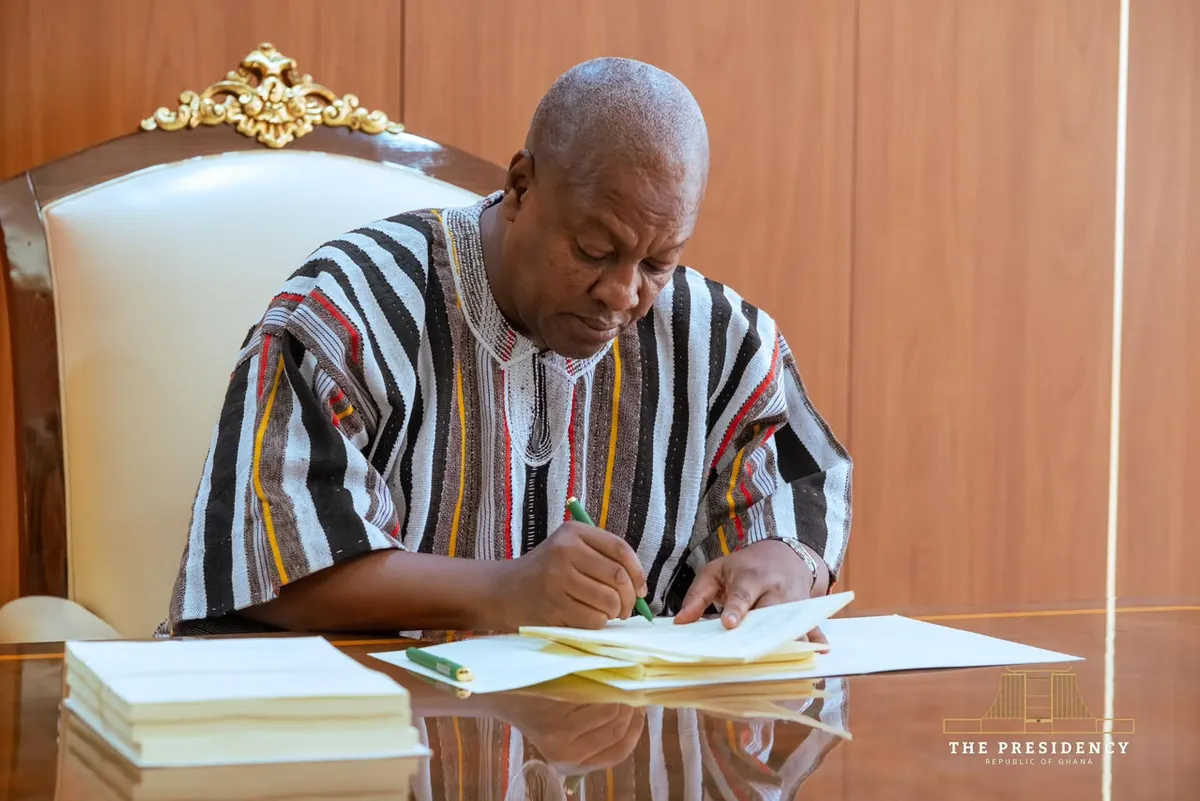

President John Dramani Mahama has expressed firm optimism that cocoa farmers across the nation will be deeply satisfied with the Ghana Cocoa Board Act 2026 reform package following his official assent to ten maMahama unveils growth plan to plug revenue leaks and modernise justice and security
As Mahama unveils growth plan initiatives across the country, President John Dramani Mahama has officially assented to ten major legislative bills. The newly enacted statutes introduce sweeping economic, agricultural, and judicial reforms designed to accelerate national growth, plug public revenue leakages, modernise justice delivery, enhance national security, and provide direct financial relief to Ghanaian workers and agricultural producers.
Speaking alongside Chief of Staff Dr Julius Debrah and state ministers during the official signing ceremony, President Mahama emphasised that this progressive legislative package fulfils key presidential campaign pledges while establishing a streamlined legal framework for long-term national development.
Mahama Unveils Growth Plan with the Ghana Cocoa Board Act 2026
A central pillar of the newly signed legislation is the Ghana Cocoa Board Act 2026 enactment, which legally binds the state to its core promises of transforming the nation’s agricultural landscape and securing equitable returns for rural farming communities.
“I’m sure our cocoa farmers will be happy,” President Mahama stated during the signing ceremony. “It incorporates the reform of the cocoa sector and includes our promise that we’re going to process at least 50% of our cocoa beans locally. Aside from that, the promise we made to farmers that they will earn 70% of the world market price of cocoa is also contained in this bill. So, promise made, promise fulfilled.”
Under the provisions of the Act, domestic cocoa processing capacity will receive regulatory support to ensure that half of all raw cocoa beans harvested within Ghana undergo local value addition before export. Simultaneously, guaranteeing farmers 70 per cent of the prevailing global market price shields rural producers from historical price volatility and boosts household incomes.
Income Tax Relief and Industrial Excise Exemptions
Beyond agricultural interventions, the legislative package addresses immediate economic relief for low-income workers and domestic industrial manufacturers:
- Income Tax Relief for Low-Wage Earners: The Income Tax (Amendment) Act, 2026 officially removes income tax burdens from minimum wage workers. “This Act exempts people who earn the minimum wage and below from paying income tax. Anybody who is on the minimum wage or below the minimum wage is exempt,” President Mahama declared.
- Excise Tax Exemptions for Local Processing: The Excise Act, 2026 consolidates excise duties, targets revenue leakage on imported dutiable goods such as alcohol and cigarettes, and grants targeted tax relief to local agribusinesses. “Importantly, it gives exemption from paying excise tax to local manufacturers of fruit juices,” President Mahama explained. “It is supposed to give them an incentive in their production. If you produce fruit juices locally, this Act exempts you from paying excise duty.”
Fiscal Discipline, Revenue Modernisation, and Judicial Reforms
To restore revenue efficiency, eliminate procedural loopholes, and modernise law enforcement, President Mahama assented to several interconnected financial and judicial statutes:
- Customs Code Consolidation: The Customs Act, 2026 unifies all historical customs laws into a single, comprehensive statute to make administration simpler and close revenue loopholes that previously caused heavy financial losses.
- Energy Levy Exemption Tightening: The Energy Sector Levies (Amendment) Act, 2026 curtails long-standing abuses of heavy fuel oil exemptions by requiring factories and maritime vessel operators to pay taxes upfront and present verifiable proof to claim reimbursements.
- VAT Alignment for Gold Reserves: The Value Added Tax (Amendment) Act, 2026 exempts large-scale gold mining companies from paying VAT on the 30 per cent portion of their total gold production surrendered directly to the Bank of Ghana for strategic national reserves.
- Community Service and Judicial Reform: The Community Service Act, 2026 introduces non-custodial sentencing options for minor offences to decongest national prisons and save taxpayer funds. “Instead of putting people in jail and the government going to have to pay for looking after prisoners for stealing goods or for committing some very minor offences, they can be sentenced to do community service for the periods that they are convicted for,” the President noted.
Additional enactments signed into law include the Tribunals Act, the Maritime and Related Offences Act (aligning domestic enforcement with international UNCLOS standards), and the National Defence University Act, 2026.