
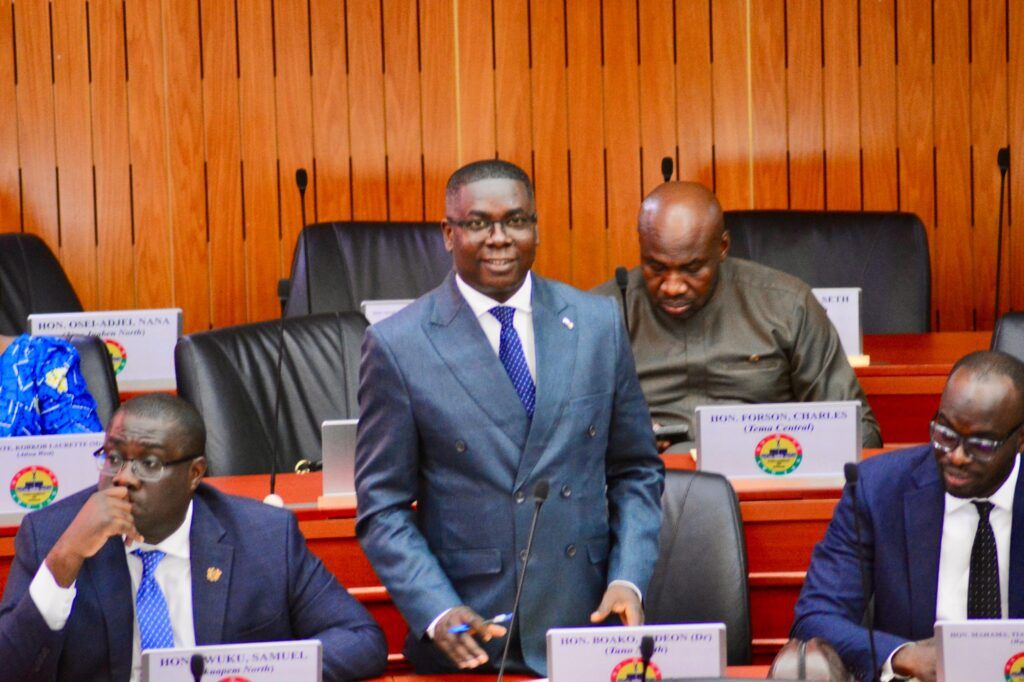

Boako: Macroeconomic Stability Must Not Be the Final Destination
Member of Parliament for Tano North, Dr. Gideon Boako, has cautioned that macroeconomic stability should not be treated as the ultimate measure of economic success, arguing that it must instead serve as a foundation for building prosperity and improving the lives of Ghanaians.
According to him, citizens do not vote based on economic statistics but on whether economic policies translate into better living conditions, jobs and opportunities.
He made the remarks in a write-up in which he questioned the extent to which recent improvements in Ghana’s macroeconomic indicators have been felt by ordinary citizens.
“Beyond the figures that look great are rising unemployment and higher cost of foodstuffs, petrol, diesel, LPGs, transport fares and unbearable general economic conditions,” he said.
Dr. Boako argued that there was a significant gap between the government’s economic indicators and the everyday experiences of many Ghanaians.
“The obvious fact is that there is a vast mismatch between the government’s decorated economic indicators and the general well-being of the Ghanaian people,” he said.
He questioned whether the reported economic recovery was translating into meaningful improvements in the lives of ordinary citizens.
“Government data paint a picture of an economy that is recovering. But after all the impressive statistics one simple question remains unanswered: Has the average Ghanaian actually felt the recovery? And, what is the quality of this recovery?” he asked.
Dr. Boako said economic growth should not be measured solely through percentages and headline indicators, but also by tangible improvements in people’s lives.
He said meaningful economic progress should be reflected in the number of young people securing decent jobs, roads being completed, nurses receiving financial clearance for recruitment, factories expanding production, communities gaining access to quality healthcare and teachers being employed.
He also said household incomes should improve to the point where families can confidently plan for the future.
However, Dr. Boako said many Ghanaians continued to experience economic hardship despite the government’s positive narrative on the economy.
“Across the country, abandoned projects have become familiar landmarks. Contractors complain about delayed or non-payments. Businesses continue to struggle with access to affordable credit. Young graduates move from one job application to another without success. Market women know that the cost of living remains painfully high compared with only a few years ago,” he said.
He described the disconnect between official economic statistics and everyday experiences as increasingly difficult to ignore.
Fiscal discipline and development
Dr. Boako also questioned the nature of the government’s reported improvement in fiscal performance.
He noted that while the government of President John Dramani Mahama had repeatedly highlighted fiscal discipline and improved budget performance, fiscal reports from the Ministry of Finance indicated that part of the improvement was driven by government spending falling significantly below amounts approved by Parliament.
“This raises an important question. Is Government genuinely becoming more efficient, or are projects simply not being implemented as planned?” he asked.
He further referred to an International Monetary Fund (IMF) report which, according to him, indicated that the government had cancelled about 1,800 ongoing projects and rephased approximately 2,000 others.
Dr. Boako said the affected projects included feeder and urban roads, drainage systems, government hostels, classroom blocks, healthcare facilities, staff accommodation, agricultural warehouses and electricity infrastructure.
He questioned whether reducing expenditure by delaying or cancelling development projects could genuinely be described as fiscal prudence if it ultimately affects the welfare of citizens.
“This raises a serious question about the quality of stability and recovery we are experiencing,” he said.
According to him, Ghana’s repeated return to the IMF for financial support should serve as a warning against focusing excessively on economic indicators without paying sufficient attention to the quality and sustainability of economic growth.
‘Fiscal discipline should not mean development paralysis’
Dr. Boako used household and business examples to illustrate his argument.
He said a family could improve its finances by cutting unnecessary expenditure, but it could also make its finances appear healthier by postponing essential repairs, delaying school expenses or refusing to fix problems in the home.
“The monthly budget may look impressive, but the underlying problems continue to grow,” he said.
He argued that the same principle applied to national budgets, saying that roads left incomplete, hospitals awaiting equipment, unpaid contractors and delayed development projects could make government expenditure figures appear favourable while citizens saw little improvement in their daily lives.
“Fiscal discipline should never become an excuse for development paralysis,” he said.
He identified employment as one of the biggest concerns, arguing that economic growth that fails to create jobs ultimately becomes “growth without hope.”
“The real purpose of economic policy is not simply to produce better statistics. It is to create opportunities that improve people’s lives,” he said.
Dr. Boako said a young graduate would gain little from a lower fiscal deficit if there was no job available after university, while farmers would not benefit from higher GDP figures if poor roads continued to prevent their produce from reaching markets.
Similarly, he said traders were more concerned about whether customers had enough disposable income to buy goods, while contractors needed actual government payments to pay their workers.
“These are the realities that define economic success,” he said.
‘Stability is only the first stage’
Dr. Boako said the government must recognise that stabilising the economy was only the first stage of national development.
He noted that Ghana, like other countries, had achieved periods of macroeconomic stability in the past, but the more difficult task had always been to translate that stability into productivity, industrialisation, employment and rising incomes.
“Ghana cannot measure success solely by lower inflation or stronger fiscal balances. Those are important foundations, but they are not the house itself,” he said.
He argued that the “house” would be built when factories increased production, agriculture became more productive, exports expanded beyond raw commodities, young people secured decent jobs, infrastructure improved and living standards steadily increased.
“That is the transformation Ghanaians are still waiting for,” he said.
Dr. Boako stressed that macroeconomic stability should serve as a platform for prosperity rather than an end in itself.
“Macroeconomic stability should never become the final destination. It should be the platform from which governments build prosperity,” he said.
He concluded that the ultimate measure of economic success was not the statistics presented by governments but the quality of life experienced by citizens.
“Ultimately, citizens do not vote for economic statistics. They vote for better lives,” he said.
“When the headlines fade and the budget documents are put away, the true verdict will not be written by economists or politicians. It will be written by the unemployed graduate searching for work, the trader trying to keep her business alive, the contractor waiting to be paid, the farmer transporting produce over poor roads and every Ghanaian family still waiting for the promise of economic recovery to arrive at their doorstep.
“Until that happens, growth without visible progress will remain an incomplete success.”
Dr. Boako added that Ghana could not achieve broad-based, shared and inclusive growth without strong and sustainable macroeconomic stability.